
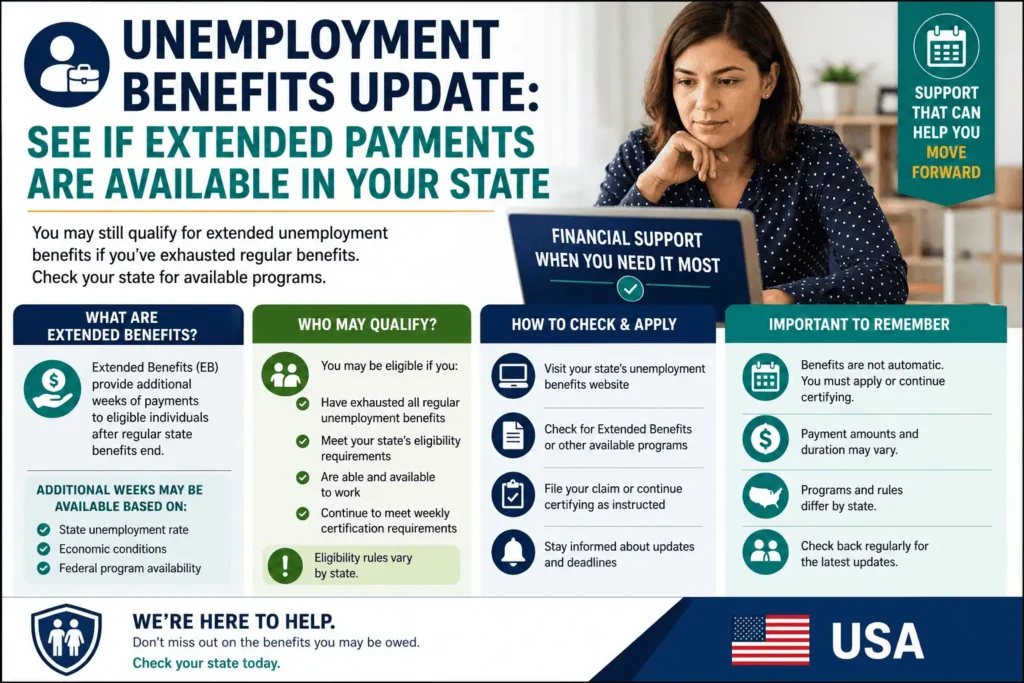
Losing a job can be one of the most stressful financial challenges anyone faces. Fortunately, unemployment insurance provides temporary financial assistance to eligible workers while they search for new employment. But what happens when your regular unemployment benefits run out and you’re still looking for work?
The good news is that in certain situations, some workers may qualify for extended unemployment benefits. These additional weeks of payments are not always available, however, because eligibility depends on economic conditions and the unemployment rate in each state.
As labor markets continue to evolve in 2026, many Americans are wondering whether their state is offering extended unemployment payments, who qualifies, and how to find out if additional assistance is available.
If you’re currently receiving unemployment benefits—or expect your regular payments to end soon—here’s everything you need to know about extended unemployment benefits and how to determine whether you may qualify.
What Are Unemployment Benefits?
Unemployment Insurance (UI) is a joint federal-state program that provides temporary financial assistance to eligible workers who lose their jobs through no fault of their own.
Although the federal government establishes broad guidelines, each state administers its own unemployment insurance program. As a result, eligibility requirements, weekly benefit amounts, application procedures, and payment durations vary from state to state.
Most individuals must actively search for work and certify their eligibility each week or every two weeks to continue receiving benefits.
What Are Extended Unemployment Benefits?
Extended Benefits (EB) are additional weeks of unemployment compensation that may become available after a person exhausts their regular state unemployment benefits.
Unlike regular unemployment insurance, Extended Benefits are only activated when a state’s unemployment rate reaches specific thresholds established under federal and state law.
The basic Extended Benefits program generally provides up to 13 additional weeks of benefits. Some states also have provisions allowing up to 20 total weeks during periods of extremely high unemployment.
Are Extended Benefits Available in Every State?
No.
One of the biggest misconceptions is that everyone automatically qualifies for extra unemployment payments once their regular benefits end.
In reality, Extended Benefits are only available when unemployment levels meet specific trigger requirements.
As of spring 2026, no state had activated the federal Extended Benefits (EB) program, meaning most claimants who exhausted their regular unemployment benefits were not eligible for additional weeks through EB.
Because unemployment conditions can change, workers should continue checking with their state unemployment agency for the latest updates.
How Long Do Regular Benefits Last?
Benefit duration depends on the state where you file your claim.
Many states provide up to 26 weeks of regular unemployment compensation, while others offer fewer weeks based on state law or unemployment rates.
Several states currently provide between 12 and 20 weeks, depending on economic conditions and individual eligibility.
Who Qualifies for Unemployment Benefits?
Although each state has different rules, applicants generally must:
- Have lost their job through no fault of their own.
- Meet minimum earnings or work history requirements.
- Be physically able to work.
- Be available to accept suitable employment.
- Actively search for work.
- File required weekly or biweekly certifications.
Individuals who voluntarily quit without a qualifying reason or who were dismissed for serious misconduct may not qualify.
Can You Qualify for Extended Benefits?
If your state activates Extended Benefits, you generally must:
- Exhaust your regular unemployment benefits.
- Continue meeting all weekly eligibility requirements.
- Remain able and available to work.
- Continue actively searching for employment.
- Meet any additional state-specific requirements.
Eligibility is determined by your state’s unemployment agency based on current federal and state rules.
How Do States Decide When to Offer Extended Benefits?
The Extended Benefits program is tied directly to unemployment statistics.
When unemployment rises above federally established trigger levels, eligible states may activate additional benefit weeks.
If unemployment later falls below those thresholds, the Extended Benefits program may end for new claimants.
This means benefit availability can change throughout the year depending on labor market conditions.
How Much Could You Receive?
Extended Benefits generally pay the same weekly amount as your regular unemployment claim.
The exact payment depends on factors such as:
- Previous earnings.
- State benefit formulas.
- Maximum weekly benefit limits.
- Any applicable deductions.
Because each state calculates benefits differently, payment amounts vary considerably across the country.
Can You Work While Receiving Benefits?
Possibly.
Many states allow recipients to work part-time while continuing to receive partial unemployment benefits.
However, you must report all earnings accurately.
Depending on your wages, your weekly unemployment payment may be reduced.
Failing to report income could result in overpayments, penalties, or repayment obligations.
Weekly Certification Requirements
Receiving unemployment benefits requires more than simply filing an initial application.
Recipients typically must complete regular certifications confirming that they:
- Remain unemployed or partially unemployed.
- Continue searching for work.
- Have not refused suitable employment.
- Report any earnings.
- Meet state eligibility rules.
Missing certification deadlines may delay or stop benefit payments.
Why Could Benefits Stop?
Benefits may end for several reasons, including:
- Finding full-time employment.
- Exhausting available weeks.
- Failing to meet work-search requirements.
- Missing required certifications.
- Becoming unavailable for work.
- Providing inaccurate information.
- State Extended Benefits ending after unemployment rates decline.
Understanding these requirements helps avoid unnecessary interruptions in payments.
How to Check If Your State Offers Extended Benefits
The easiest way to determine whether additional unemployment payments are available is by checking with your state’s unemployment insurance agency.
Most state agencies provide information about:
- Benefit duration.
- Weekly payment amounts.
- Extended Benefit availability.
- Application status.
- Weekly certification requirements.
- Appeals procedures.
Because unemployment programs are administered individually by each state, official state agencies remain the best source for current eligibility information.
What If You Exhaust All Benefits?
If your regular unemployment benefits end and your state has not activated Extended Benefits, you may still qualify for other assistance programs depending on your circumstances.
Some individuals may be eligible for:
- Workforce development programs.
- Job training opportunities.
- Career counseling.
- Employment placement services.
- State workforce assistance programs.
- Food assistance programs.
- Health coverage through Medicaid or other qualifying programs.
State workforce agencies often provide free employment resources to help individuals return to work as quickly as possible.
Common Reasons Claims Are Denied
Applications may be denied for reasons such as:
- Voluntarily leaving employment without good cause.
- Termination for disqualifying misconduct.
- Insufficient earnings during the qualifying period.
- Failure to actively seek employment.
- Failure to respond to agency requests.
- Providing incomplete or inaccurate information.
Applicants who disagree with a decision usually have the right to file an appeal within the timeframe established by their state.
Frequently Asked Questions
Are extended unemployment benefits automatic?
No. Extended Benefits are only available when a state’s unemployment rate meets legal trigger requirements. Even then, eligible claimants must continue meeting all program rules.
How many extra weeks are available?
The basic Extended Benefits program can provide up to 13 additional weeks. In some circumstances, states may provide up to 20 weeks during periods of exceptionally high unemployment.
Is every state offering extended payments in 2026?
No. As of recent federal reporting in 2026, no states had activated the federal Extended Benefits program because unemployment levels had not reached the required thresholds.
Can I receive unemployment if I work part-time?
Possibly. Many states allow partial unemployment benefits, but all earnings must be reported and may reduce your weekly payment.
Can I appeal if my claim is denied?
Yes. Most state unemployment agencies allow applicants to appeal benefit determinations if they believe an error occurred.
Tips for Unemployment Benefit Recipients
If you’re currently receiving unemployment benefits, consider these best practices:
- File your weekly certifications on time.
- Keep records of your job search activities.
- Report all income accurately.
- Read all notices from your state unemployment agency.
- Update your address and banking information promptly.
- Monitor your claim regularly for any changes in eligibility.
Staying organized can help prevent delays and ensure you continue receiving benefits if you remain eligible.
Final Thoughts
Unemployment benefits provide an important financial safety net for workers who lose their jobs unexpectedly, and Extended Benefits can offer additional support during periods of high unemployment. However, these extra payments are not always available and depend on economic conditions in each state.
If you’re nearing the end of your regular unemployment benefits, now is the time to check with your state’s unemployment agency to see whether any extended payments or other employment assistance programs are available. Staying informed, meeting certification requirements, and continuing your job search can help you make the most of the benefits and resources available while you work toward your next employment opportunity.
You may qualify for extended unemployment benefits depending on your state’s program, economic conditions and your previous employment history, which could provide additional weeks of financial support.
CHECK HERE FOR UNEMPLOYMENT BENEFITS IN THE UNITED STATES
- Unemployment Benefits Information 🇺🇸
- U.S. Department of Labor Resources 🇺🇸
- Find State Unemployment Offices 🇺🇸
- Search Assistance Programs 🇺🇸