
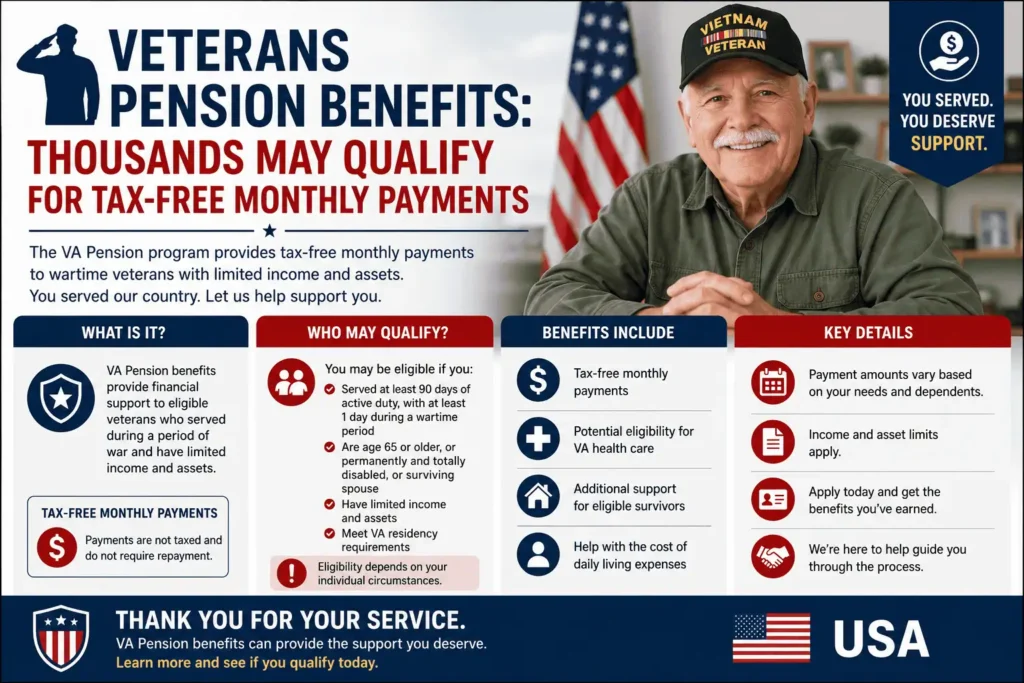
Many U.S. veterans spend years serving their country without realizing they may qualify for valuable financial assistance later in life. While many people are familiar with disability compensation or military retirement pay, fewer know about the Veterans Pension program—a federal benefit that provides tax-free monthly payments to wartime veterans with limited income.
For thousands of eligible veterans and surviving family members, these monthly payments can help cover everyday expenses such as housing, food, healthcare, transportation, and other essential needs. Yet every year, many eligible individuals never apply simply because they are unaware the program exists or mistakenly believe they do not qualify.
If you served during a qualifying wartime period and meet certain age, disability, and financial requirements, you may be eligible for this important benefit. Understanding the eligibility rules, income limits, and application process can help you determine whether you or a loved one could receive monthly tax-free payments through the U.S. Department of Veterans Affairs (VA).
Here’s everything you need to know about Veterans Pension benefits in 2026.
What Is the Veterans Pension Program?
The Veterans Pension is a needs-based benefit administered by the U.S. Department of Veterans Affairs (VA). It provides tax-free monthly payments to eligible wartime veterans who have limited income and net worth and who meet specific age or disability requirements.
Unlike military retirement pay, Veterans Pension benefits are not based on rank, years of service beyond the minimum eligibility requirements, or disability connected to military service.
Instead, the program is intended to provide financial assistance to veterans whose income falls below limits established by the VA.
Because the payments are tax-free, recipients receive the full benefit amount without federal income tax being deducted.
Who May Qualify?
To qualify for Veterans Pension benefits, applicants generally must satisfy several eligibility requirements.
In most cases, an applicant must:
- Be a veteran who served on active duty.
- Have served during a recognized wartime period.
- Meet minimum active-duty service requirements.
- Have received a discharge other than dishonorable.
- Meet income and net worth limits.
- Be age 65 or older, or permanently and totally disabled, or meet another qualifying condition established by the VA.
Meeting one requirement alone does not automatically guarantee approval, as all eligibility factors are reviewed during the application process.
What Counts as Wartime Service?
One common misconception is that a veteran must have served in a combat zone to qualify.
In reality, Veterans Pension eligibility generally depends on serving during an officially recognized wartime period, even if the veteran was never deployed to an active combat area.
Examples of recognized wartime periods include:
- World War II.
- Korean War.
- Vietnam War.
- Gulf War.
Specific service dates are established by federal law, and the VA reviews military service records to determine eligibility.
How Much Could You Receive?
The amount of a Veterans Pension payment depends on several factors, including:
- Annual household income.
- Countable assets.
- Marital status.
- Number of dependents.
- Eligibility for additional pension supplements.
Rather than paying a fixed amount to every recipient, the VA generally calculates benefits by comparing a veteran’s countable income with the applicable Maximum Annual Pension Rate (MAPR).
If approved, recipients typically receive monthly payments based on this calculation.
Why Are These Payments Tax-Free?
One of the most valuable features of the Veterans Pension program is that payments are generally exempt from federal income tax.
This means eligible veterans receive the benefit without having to report it as taxable income for federal tax purposes.
Because tax laws can vary depending on individual circumstances, veterans with questions about state taxes or other financial issues may wish to consult a qualified tax professional.
Income and Net Worth Requirements
Since Veterans Pension is a needs-based program, financial eligibility plays an important role.
The VA reviews:
- Household income.
- Certain medical expenses.
- Savings.
- Investments.
- Other countable assets.
Not all income and assets are treated the same.
For example, some unreimbursed medical expenses may reduce countable income, potentially allowing additional veterans to qualify.
Because financial rules can be complex, applicants should provide complete and accurate information during the application process.
Permanent Disability Can Also Qualify
Veterans under age 65 may still qualify if they are permanently and totally disabled because of a condition that is not the result of willful misconduct.
The disability does not have to be connected to military service.
This is an important distinction because service-connected disabilities are generally evaluated under a separate VA Disability Compensation program.
Additional Benefits Through Aid and Attendance
Some Veterans Pension recipients may qualify for higher monthly payments through the Aid and Attendance benefit.
This additional pension amount may be available to veterans who:
- Need assistance with daily activities.
- Require help bathing, dressing, or eating.
- Live in a nursing home.
- Have severe visual impairment.
- Require regular assistance from another person.
Aid and Attendance can significantly increase monthly pension payments for eligible veterans.
Housebound Benefits
Veterans who spend most of their time confined to their homes because of permanent disabilities may also qualify for Housebound benefits.
Although veterans generally cannot receive both Aid and Attendance and Housebound benefits simultaneously, the VA determines which benefit provides the greatest assistance based on the individual’s circumstances.
Can Surviving Spouses Qualify?
Yes.
Certain surviving spouses and unmarried dependent children may qualify for Survivors Pension benefits if they meet financial and eligibility requirements.
Surviving spouses must generally not have remarried before meeting applicable eligibility rules.
The Survivors Pension program provides financial assistance similar to the Veterans Pension program for qualifying family members.
What Documents Will You Need?
Preparing documentation before applying can make the process easier.
Common documents include:
- DD Form 214 or other military discharge papers.
- Social Security numbers.
- Financial records.
- Income documentation.
- Bank statements.
- Medical expense records.
- Marriage certificates, if applicable.
- Dependency information.
Providing complete documentation can help reduce delays during the review process.
How Do You Apply?
Applications may be submitted through the U.S. Department of Veterans Affairs.
Veterans can generally apply:
- Online.
- By mail.
- In person at a VA regional office.
- With assistance from an accredited Veterans Service Organization (VSO).
Many veterans choose to work with accredited representatives because they can help ensure applications are complete and properly documented.
Common Reasons Applications Are Delayed or Denied
Although many applicants qualify, delays and denials can occur.
Some common reasons include:
- Missing military records.
- Incomplete financial documentation.
- Income exceeding eligibility limits.
- Net worth above program limits.
- Incomplete application forms.
- Failure to respond to VA requests for additional information.
Applicants who disagree with a decision may have appeal rights under VA procedures.
Can You Receive Other VA Benefits?
Possibly.
Eligibility for one VA benefit does not automatically prevent someone from receiving another.
However, veterans generally cannot receive full Veterans Pension payments and VA Disability Compensation at the same time. If a veteran qualifies for both, the VA usually pays the benefit that results in the greater financial advantage, unless specific exceptions apply.
Veterans should review their individual circumstances carefully before making decisions about benefit elections.
Frequently Asked Questions
Are Veterans Pension payments taxable?
No. Veterans Pension benefits are generally tax-free under federal law.
Do I have to be retired?
No. While many recipients are retired because of age or disability, retirement itself is not a requirement. Eligibility depends on meeting the program’s service, financial, and age or disability criteria.
Do I need a service-connected disability?
No. Veterans Pension is different from VA Disability Compensation. A service-connected disability is not required for Pension eligibility.
Can surviving spouses receive benefits?
Yes. Eligible surviving spouses may qualify for Survivors Pension if they satisfy the applicable financial and program requirements.
Does serving during wartime mean serving in combat?
No. Many veterans qualify because they served during an officially recognized wartime period, even if they were never deployed to a combat zone.
Tips Before Applying
If you believe you may qualify, these suggestions can help make the process smoother:
- Gather all military service records.
- Organize financial documents before applying.
- Keep receipts for eligible medical expenses.
- Review your discharge status.
- Respond promptly to any VA requests.
- Consider seeking free assistance from an accredited Veterans Service Organization.
Being prepared can help reduce delays and improve the overall application experience.
Why This Benefit Matters
For veterans living on fixed incomes, the Veterans Pension program can provide valuable financial stability. Monthly tax-free payments may help cover essential expenses that become more difficult to manage during retirement or after a disabling medical condition.
In addition to basic pension payments, programs such as Aid and Attendance and Housebound benefits offer additional support for veterans who require daily assistance or have significant medical needs. These supplemental benefits can make a substantial difference in maintaining independence and improving quality of life.
Final Thoughts
The Veterans Pension program remains one of the most valuable yet underutilized benefits available to eligible wartime veterans with limited income. Because the payments are tax-free and designed to help cover essential living expenses, they can provide meaningful financial relief for veterans and their families.
If you served during a qualifying wartime period and meet the program’s age, disability, income, and net worth requirements, it may be worthwhile to explore whether you qualify. Gathering the necessary documentation, understanding the eligibility rules, and submitting a complete application could help you access monthly financial support that honors your military service while strengthening your financial security.
Veterans may qualify for tax-free monthly pension payments if they meet service, income and age or disability requirements established by the Department of Veterans Affairs.
CHECK HERE FOR VETERANS PENSION BENEFITS IN THE UNITED STATES
- VA Pension Eligibility 🇺🇸
- Apply for Veterans Pension 🇺🇸
- Government Benefits for Veterans 🇺🇸
- Find Additional Assistance Programs 🇺🇸