
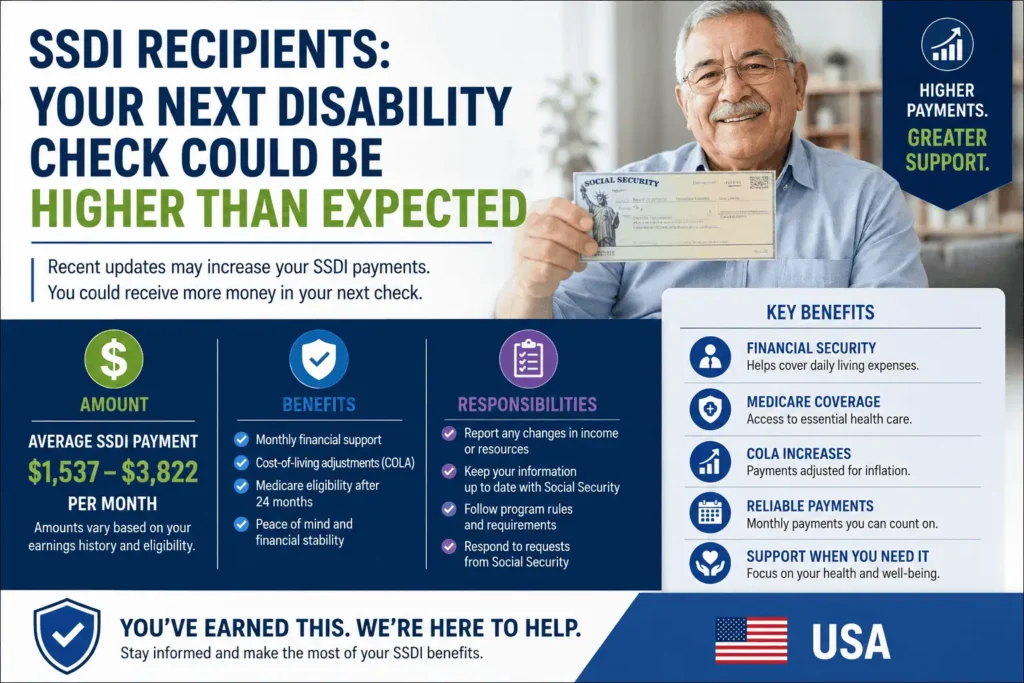
Millions of Americans who receive Social Security Disability Insurance (SSDI) may notice that their next monthly payment is larger than expected. Thanks to the latest Cost-of-Living Adjustment (COLA), updated benefit calculations, and other factors that can affect disability payments, many beneficiaries are receiving more money in 2026 than they did the previous year.
If you depend on SSDI benefits to help pay for housing, groceries, utilities, transportation, and medical expenses, even a modest increase can make a meaningful difference. However, not every recipient understands why their payment amount changes or whether they qualify for additional benefits beyond the standard monthly check.
Whether you are already receiving SSDI or are considering applying for disability benefits, understanding the latest payment updates can help you make informed financial decisions and ensure you receive every dollar you are entitled to.
Here is everything you need to know about why your next SSDI payment could be higher than expected.
What Is SSDI?
Social Security Disability Insurance, commonly known as SSDI, is a federal program administered by the Social Security Administration (SSA). It provides monthly financial assistance to workers who have developed a qualifying disability and are no longer able to perform substantial work.
Unlike Supplemental Security Income (SSI), SSDI is based on your employment history and the Social Security taxes you paid while working. To qualify, applicants generally need to have earned enough work credits before becoming disabled.
The program is designed to replace a portion of lost income for workers whose medical condition is expected to last at least one year or result in death.
Why Are SSDI Payments Higher in 2026?
One of the biggest reasons disability payments have increased is the annual Cost-of-Living Adjustment (COLA). Each year, the Social Security Administration reviews inflation data to determine whether benefits should be adjusted to help recipients keep pace with rising prices.
For 2026, Social Security beneficiaries, including SSDI recipients, received a 2.8% COLA increase. This adjustment helps offset higher costs for essential expenses such as food, rent, healthcare, transportation, and utilities.
The increase is applied automatically to eligible beneficiaries, meaning recipients do not need to submit a new application or request the adjustment.
How Much Could Your Payment Increase?
The amount of your monthly increase depends on your current benefit.
Because COLA is calculated as a percentage, recipients with larger monthly benefits generally receive a larger dollar increase.
For example:
- A recipient receiving $1,000 per month would receive approximately $28 more each month.
- Someone receiving $1,500 per month would receive roughly $42 more.
- A beneficiary receiving $2,000 monthly would see an increase of about $56.
Your exact payment depends on your individual benefit calculation, work history, and other eligibility factors.
What Determines Your SSDI Benefit Amount?
Unlike SSI, SSDI benefits are not based on financial need.
Instead, your monthly payment is primarily determined by:
- Your lifetime earnings.
- The amount of Social Security taxes you paid.
- Your average indexed monthly earnings.
- Your work history before becoming disabled.
Workers who earned higher wages over longer careers generally qualify for higher SSDI benefits than workers with shorter or lower-paying employment histories.
Who Qualifies for SSDI?
Not everyone with a disability qualifies for SSDI.
Generally, applicants must meet both medical and work requirements.
Medical eligibility usually requires:
- A severe physical or mental impairment.
- A condition expected to last at least 12 months or result in death.
- An inability to perform substantial gainful activity because of the disability.
Work eligibility typically requires earning enough Social Security work credits before becoming disabled.
The exact number of credits required depends on your age when the disability began.
Is the Increase Automatic?
Yes.
Current SSDI recipients do not need to apply separately for the annual COLA increase.
The Social Security Administration automatically updates monthly payments for eligible beneficiaries.
Most recipients receive a notice explaining their new monthly benefit amount before the increased payment takes effect.
Could Your Payment Increase for Other Reasons?
While COLA is the most common reason for higher benefits, there are several additional situations that may result in a larger monthly payment.
These include:
- Correction of previous earnings records.
- Recalculation of benefit amounts after updated wage information.
- Changes involving workers’ compensation offsets.
- Resolution of benefit appeals.
- Changes affecting family benefits.
- Removal of certain payment reductions.
Some beneficiaries may also receive retroactive payments if a previous underpayment is corrected.
Family Members May Also Receive Benefits
Certain family members of SSDI recipients may qualify for benefits based on the disabled worker’s record.
Eligible family members may include:
- A spouse.
- Minor children.
- Adult children with qualifying disabilities that began before age 22.
- In some situations, former spouses.
Family benefits are subject to maximum payment limits established by the Social Security Administration.
Medicare Eligibility After SSDI
Many SSDI recipients eventually qualify for Medicare coverage.
In most cases, beneficiaries become eligible for Medicare after receiving SSDI benefits for 24 months.
Medicare helps cover healthcare expenses, including hospital services, physician visits, and prescription medications through various coverage options.
For many disability beneficiaries, Medicare provides valuable financial protection against expensive medical bills.
Can You Work While Receiving SSDI?
Yes.
Receiving SSDI does not automatically prevent you from working.
The Social Security Administration offers several work incentive programs that allow beneficiaries to test their ability to return to work without immediately losing benefits.
Programs such as the Trial Work Period allow eligible recipients to earn income while continuing to receive SSDI for a limited time.
If earnings eventually exceed allowable limits, benefits may be affected.
Understanding these rules can help beneficiaries transition back into the workforce without unexpected interruptions in income.
What If Your Disability Improves?
The Social Security Administration periodically reviews disability cases to determine whether beneficiaries continue to meet medical eligibility requirements.
These reviews are known as Continuing Disability Reviews (CDRs).
If medical evidence shows significant improvement that allows substantial work, benefits could eventually stop.
However, many recipients continue receiving benefits for years if their disabling condition remains severe.
Common Reasons Applications Are Denied
Many first-time SSDI applications are denied.
Some of the most common reasons include:
- Insufficient medical evidence.
- Failure to meet work credit requirements.
- The condition is not expected to last long enough.
- The applicant is still able to perform substantial work.
- Missing documentation.
- Incomplete application forms.
Applicants who receive a denial often have the right to appeal the decision, and many claims are approved during later stages of the appeals process.
How to Check Your Benefit Amount
Recipients can verify their payment information by reviewing their annual COLA notice or by accessing their personal Social Security account.
Your account allows you to:
- View payment history.
- Confirm your monthly benefit amount.
- Update direct deposit information.
- Access benefit verification letters.
- Review earnings records.
- Monitor important notices from the Social Security Administration.
Regularly reviewing your account helps ensure your earnings history is accurate, which can affect future benefit calculations.
Tips to Maximize Your Benefits
Although SSDI payments are calculated using established formulas, there are several ways to help ensure you receive the correct amount.
Helpful tips include:
- Review your earnings record for errors.
- Report address changes promptly.
- Notify the SSA of changes in work activity.
- Keep medical records updated.
- Respond quickly to SSA requests for information.
- Monitor your annual COLA notices.
Small administrative errors can sometimes delay payments or result in incorrect benefit amounts.
Frequently Asked Questions
Will everyone receive the same increase?
No. Because the annual COLA is percentage-based, the dollar amount varies depending on each person’s monthly benefit.
Do I need to file paperwork to receive the increase?
No. The Social Security Administration applies the annual COLA adjustment automatically for eligible recipients.
Can SSDI payments change during the year?
Yes. Payments may change because of work activity, benefit recalculations, workers’ compensation offsets, family benefit adjustments, or corrections to earnings records.
Can I receive both SSDI and SSI?
Yes. Some individuals qualify for both programs if they meet the separate eligibility requirements for each.
Will Medicare premiums affect my payment?
For some beneficiaries, Medicare Part B premiums are deducted directly from Social Security benefits, which may affect the net amount deposited into their bank account.
Final Thoughts
If your next SSDI disability check is higher than expected, the increase is likely the result of the 2026 Cost-of-Living Adjustment or another benefit recalculation by the Social Security Administration. While the annual increase may seem modest, it provides valuable financial support as the cost of everyday necessities continues to rise.
Understanding how SSDI benefits are calculated, knowing what factors can affect your payment, and regularly reviewing your Social Security records can help ensure you receive the full amount you have earned through your work history.
Whether you are a longtime beneficiary or recently approved for disability benefits, staying informed about payment updates is one of the best ways to protect your financial security and make the most of the benefits available through the SSDI program.
Your SSDI payment may increase due to cost-of-living adjustments (COLA) and updated benefit calculations, depending on your eligibility and work history.
CHECK HERE FOR SSDI BENEFITS AND INFORMATION IN THE UNITED STATES
- SSDI Eligibility Requirements 🇺🇸
- Apply for Disability Benefits 🇺🇸
- Government Disability Programs 🇺🇸
- Find Additional Assistance Programs 🇺🇸
Hi, this is a comment.
To get started with moderating, editing, and deleting comments, please visit the Comments screen in the dashboard.
Commenter avatars come from Gravatar.