
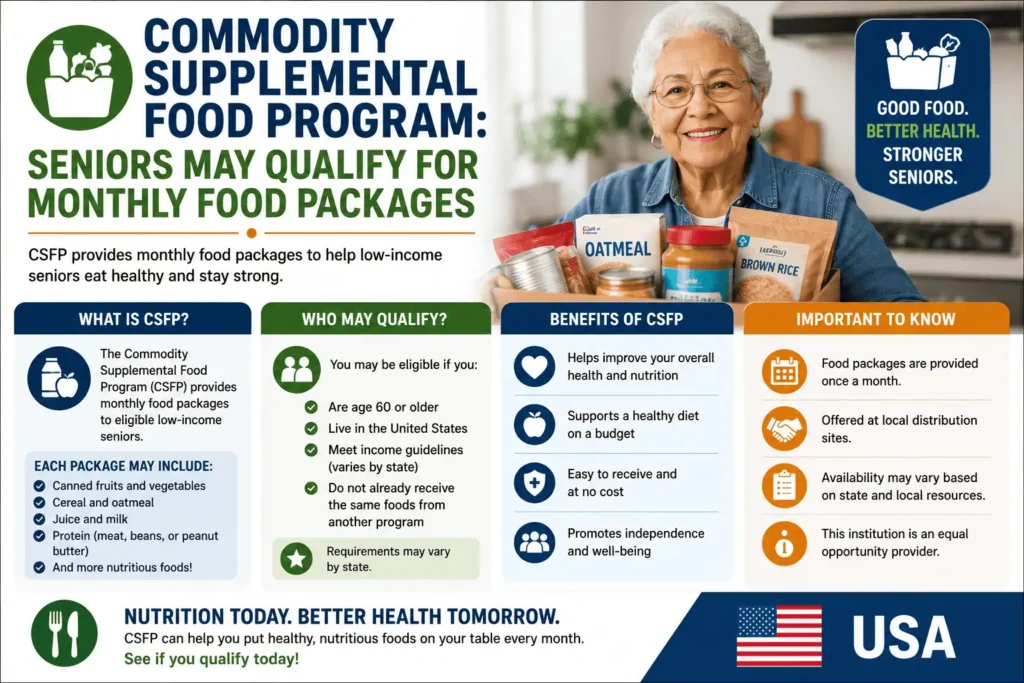
For many older Americans living on fixed incomes, stretching a monthly budget has become increasingly difficult. Rising grocery prices, healthcare expenses, housing costs, and utility bills often leave seniors searching for additional ways to afford nutritious meals. Fortunately, one federal nutrition assistance program continues to help thousands of eligible older adults by providing free monthly food packages filled with healthy pantry staples.
The Commodity Supplemental Food Program (CSFP) is designed specifically to improve the nutritional health of low-income seniors by distributing USDA food packages through local agencies and community organizations. Although the program has been available for many years, many eligible seniors have never heard of it or mistakenly assume they do not qualify.
In 2026, eligible adults aged 60 and older may continue to receive monthly food packages that include nutritious items such as canned fruits and vegetables, cereal, pasta, dairy products, shelf-stable milk, peanut butter, and other healthy foods. While the exact contents may vary by location, the goal remains the same: helping older adults maintain a balanced diet while reducing monthly grocery expenses.
If you or someone you know is struggling with food costs, here’s everything you need to know about the Commodity Supplemental Food Program and how to determine whether you may qualify.
What Is the Commodity Supplemental Food Program?
The Commodity Supplemental Food Program (CSFP) is a federal nutrition assistance program administered by the U.S. Department of Agriculture (USDA).
Rather than providing cash benefits or an Electronic Benefit Transfer (EBT) card, CSFP distributes boxes or packages of USDA foods each month through participating local agencies, food banks, and nonprofit organizations.
The program is specifically intended to supplement—not replace—a senior’s regular grocery purchases by providing nutritious foods that support good health.
Today, CSFP operates in many states, tribal organizations, and U.S. territories through local distribution partners.
Who May Qualify?
CSFP primarily serves older adults with limited financial resources.
In general, applicants must:
- Be at least 60 years of age.
- Meet income eligibility guidelines established for the program.
- Live in an area where CSFP is available.
Because the program is administered locally, exact eligibility procedures and enrollment requirements may vary slightly depending on the state or agency managing the program.
Some locations may also have waiting lists if available funding has been fully allocated.
Income Guidelines
Income is one of the primary factors used to determine eligibility.
Each year, income limits are updated based on federal poverty guidelines.
Applicants generally must have household income below the maximum level established for their household size.
Because these limits change periodically, seniors who were previously ineligible may qualify after updated guidelines take effect.
If your income has recently decreased due to retirement, reduced work hours, or other financial changes, reviewing the current requirements may be worthwhile.
What Foods Are Included?
One of the greatest advantages of CSFP is the variety of nutritious foods provided each month.
Although food packages vary somewhat by state and local distribution agency, they commonly include:
- Canned vegetables.
- Canned fruit.
- Shelf-stable milk.
- Cheese.
- Dry beans.
- Peanut butter.
- Rice.
- Pasta.
- Oatmeal.
- Breakfast cereal.
- Juice.
- Canned meat.
- Canned poultry.
- Canned fish.
- Flour.
- Cornmeal.
Food packages are designed to supplement a healthy diet and provide important nutrients commonly needed by older adults.
Local agencies may occasionally substitute items depending on product availability.
Why the Program Matters
Many seniors live on fixed monthly incomes that do not increase as quickly as everyday living expenses.
Even modest increases in grocery prices can make it difficult to purchase healthy foods consistently.
CSFP helps reduce some of that financial pressure by providing food that can be used to prepare nutritious meals throughout the month.
The money seniors save on groceries can often be redirected toward other essential expenses such as:
- Prescription medications.
- Rent or mortgage payments.
- Utility bills.
- Transportation.
- Healthcare costs.
For many participants, the program becomes an important part of maintaining financial stability.
Does CSFP Replace SNAP?
No.
The Commodity Supplemental Food Program is separate from the Supplemental Nutrition Assistance Program (SNAP).
Many seniors qualify for both programs at the same time.
While SNAP provides monthly grocery purchasing benefits through an EBT card, CSFP provides physical food packages.
Receiving one benefit does not automatically prevent someone from receiving the other, provided all program requirements are met.
How Are Food Packages Distributed?
Food packages are typically distributed once each month through participating organizations.
Distribution sites may include:
- Local food banks.
- Community action agencies.
- Senior centers.
- Churches.
- Nonprofit organizations.
- County assistance offices.
Some communities also offer home delivery services for seniors who have difficulty traveling because of health or mobility challenges.
Availability depends on local resources.
How Do You Apply?
Applications are submitted through the local agency administering CSFP in your area.
The process usually includes:
- Completing an application.
- Verifying age.
- Providing proof of income.
- Confirming residency.
- Meeting any local enrollment requirements.
Because enrollment procedures vary, applicants should contact their local CSFP provider for detailed instructions.
Documents You May Need
Preparing documentation before applying can help simplify the process.
Commonly requested documents include:
- Government-issued photo identification.
- Proof of age.
- Proof of address.
- Social Security number, if requested.
- Income documentation.
- Benefit award letters.
- Pension statements.
- Recent pay stubs if still employed.
Providing accurate and complete information can help reduce application delays.
Can Working Seniors Qualify?
Yes.
Although many participants are retired, employment does not automatically prevent eligibility.
Some working seniors with modest incomes still meet the program’s financial guidelines.
Eligibility depends on household income rather than employment status alone.
Can Married Couples Participate?
Yes.
If both spouses meet the eligibility requirements, they may each qualify depending on household income and local program rules.
Income calculations are generally based on the household as a whole.
Applicants should review their local agency’s policies for specific guidance.
Is There a Waiting List?
Possibly.
Because funding is limited, some local agencies maintain waiting lists when demand exceeds available resources.
If your area currently has a waiting list, submitting an application may still be beneficial because applicants are often contacted as additional funding or program openings become available.
Can Someone Pick Up My Food Package?
Many local agencies allow an authorized representative to pick up food packages on behalf of an eligible participant.
This option can be especially helpful for seniors with mobility limitations, transportation challenges, or health conditions.
Policies vary by agency, so participants should ask about authorization requirements.
Frequently Asked Questions
How much does the program cost?
The food packages are provided at no cost to eligible participants.
Do I receive cash instead of food?
No. CSFP provides food packages rather than cash or electronic grocery benefits.
Can I receive SNAP and CSFP together?
Yes. Many seniors receive assistance through both programs if they meet the eligibility requirements for each.
Are the foods healthy?
Yes. USDA food packages are selected to provide nutritious foods that support the dietary needs of older adults.
Do all states participate?
Most states administer CSFP, but availability and enrollment procedures vary by location. Some counties or service areas may have different participating agencies or capacity limits.
Tips Before Applying
If you believe you may qualify, these suggestions can help make the application process easier:
- Contact your local CSFP distribution agency before visiting.
- Ask about current income guidelines.
- Gather identification and proof of income in advance.
- Inquire about waiting lists if enrollment is full.
- Ask whether home delivery or authorized pickup options are available.
- Keep copies of any documents you submit.
Being prepared can help ensure your application is processed as smoothly as possible.
Additional Community Resources
Many organizations that distribute CSFP food packages also connect seniors with other valuable services.
Depending on your community, you may receive information about:
- Senior meal programs.
- SNAP enrollment assistance.
- Healthcare referrals.
- Transportation services.
- Utility assistance programs.
- Nutrition education.
- Community wellness programs.
Taking advantage of these additional resources can further improve financial stability and overall well-being.
Final Thoughts
The Commodity Supplemental Food Program continues to provide meaningful nutritional support for older Americans who are struggling with rising food costs. Through free monthly food packages filled with healthy pantry staples, the program helps eligible seniors maintain a balanced diet while easing the financial burden of grocery shopping.
If you are at least 60 years old and living on a limited income, it may be worthwhile to explore whether CSFP is available in your community. Even if you’ve never applied before—or believed you earned too much in the past—updated income guidelines and changing financial circumstances could make you eligible today. Reviewing your local program requirements, gathering the necessary documents, and completing an application could help you receive monthly food assistance that supports both your health and your household budget throughout the year.
Seniors may qualify for monthly food packages through CSFP if they are 60 years or older and meet income eligibility guidelines, helping supplement their diets with nutritious USDA foods.
CHECK HERE FOR CSFP BENEFITS IN THE UNITED STATES
- CSFP Program Overview 🇺🇸
- Apply for Food Assistance 🇺🇸
- Check Eligibility for CSFP 🇺🇸
- Find Local Distribution Agencies 🇺🇸