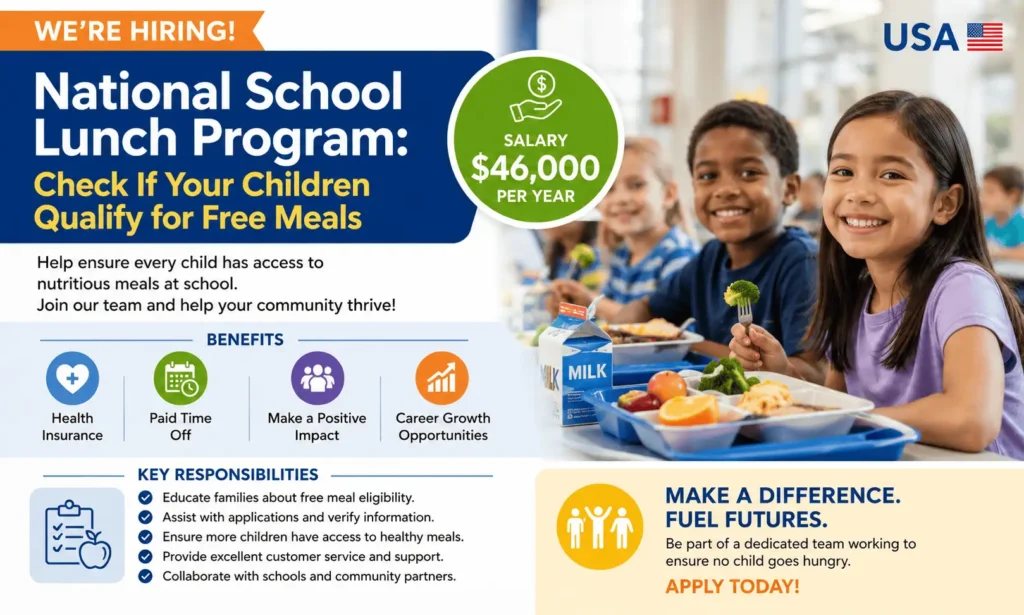
With grocery prices continuing to strain household budgets, many parents are looking for ways to reduce monthly expenses while ensuring their children receive healthy, nutritious meals every day. One of the most valuable resources available to families across the United States is the National School Lunch Program (NSLP), a federal initiative that provides free or low-cost lunches to millions of students each school year.
As the 2026–2027 school year begins, updated income eligibility guidelines and expanded participation in certain school meal programs could allow more children to qualify for free or reduced-price meals. In some school districts, every enrolled student receives breakfast and lunch at no cost through special federal provisions, eliminating the need for families to submit meal applications.
If you’re wondering whether your child is eligible, understanding how the program works can help your family take advantage of an important benefit that supports both your child’s health and your household budget.
Here’s everything you need to know about the National School Lunch Program and the latest eligibility updates.
What Is the National School Lunch Program?
The National School Lunch Program (NSLP) is a federally assisted meal program administered by the U.S. Department of Agriculture (USDA). It provides nutritionally balanced lunches to students attending participating public schools, nonprofit private schools, and certain residential child care institutions.
Established in 1946, the program helps ensure that children have access to healthy meals during the school day while reducing food costs for eligible families.
Millions of students participate in the program every year, making it one of the largest child nutrition initiatives in the country.
Who May Qualify?
Children may qualify for free or reduced-price school meals through several different pathways.
Eligibility is generally based on:
- Household income.
- Household size.
- Participation in certain public assistance programs.
- Attendance at schools participating in special federal meal provisions.
Some children are automatically eligible without completing a traditional application if they are directly certified through qualifying assistance programs.
Updated Income Guidelines for 2026–2027
Every year, the USDA updates the income eligibility guidelines used by schools to determine whether students qualify for free or reduced-price meals.
These updated limits are based on the federal poverty guidelines and became effective for the 2026–2027 school year. Because of the annual adjustments, some families who previously earned too much may now qualify for assistance.
Income limits vary according to household size, so larger families generally qualify at higher income levels.
Automatic Eligibility Through Other Programs
Many children do not need to submit a school meal application because they qualify automatically.
Automatic eligibility may apply to children whose households participate in programs such as:
- Supplemental Nutrition Assistance Program (SNAP).
- Temporary Assistance for Needy Families (TANF).
- Food Distribution Program on Indian Reservations (FDPIR).
Schools often verify eligibility directly through state systems, reducing paperwork for families.
Community Eligibility Provision (CEP)
One of the biggest advantages for many families is the Community Eligibility Provision (CEP).
Schools participating in CEP serve breakfast and lunch free of charge to every enrolled student, regardless of individual household income. Families at CEP schools generally do not need to submit free or reduced-price meal applications for their children to receive school meals.
Participation in CEP continues to expand in many communities, allowing more students to benefit from free meals.
What Meals Are Provided?
Participating schools provide meals that meet federal nutrition standards.
School lunches typically include:
- Fruits.
- Vegetables.
- Whole grains.
- Lean proteins.
- Low-fat or fat-free milk.
Menus are designed to support children’s growth, learning, and overall health while following USDA nutrition requirements.
Why School Meals Matter
Healthy nutrition plays an important role in academic success.
Research has consistently shown that students who have access to nutritious meals are better able to:
- Focus in class.
- Participate in learning activities.
- Maintain consistent attendance.
- Support healthy physical development.
- Improve overall well-being.
For many families, school meals also reduce the financial pressure of preparing lunches every day.
Can Homeschooled Children Participate?
Generally, the National School Lunch Program serves students enrolled in participating schools.
Homeschooled students are typically not eligible unless they attend a participating educational program that offers school meals under federal guidelines.
Eligibility rules may vary depending on state and local educational arrangements.
Do Private Schools Participate?
Yes.
Many nonprofit private schools choose to participate in the National School Lunch Program.
Families with children attending participating private schools may qualify under the same federal income guidelines used for public schools.
Parents can check with their child’s school to determine whether the program is available.
How Do Families Apply?
If your child’s school does not participate in the Community Eligibility Provision or direct certification, you may need to complete a meal application.
The application process generally includes:
- Providing household income information.
- Listing all household members.
- Reporting participation in qualifying assistance programs, if applicable.
- Certifying that the information is accurate.
Many schools now allow families to submit applications online, making the process faster and more convenient.
Documents You May Need
When completing an application, schools may request documentation such as:
- Proof of household income.
- Recent pay stubs.
- Benefit award letters.
- Identification information.
- Documentation for public assistance participation, if requested.
Providing complete and accurate information helps schools process applications more efficiently.
Can Eligibility Change During the School Year?
Yes.
Families can often apply at any time during the school year.
If your household experiences changes such as:
- Job loss.
- Reduced work hours.
- Lower household income.
- Addition of a new family member.
your child may become eligible even if they did not qualify earlier in the year.
Parents should notify their school if their financial circumstances change.
What If Your Application Is Denied?
If your application is denied, you may have options.
Families generally have the right to:
- Request a review.
- Submit additional documentation.
- Appeal the decision according to school district procedures.
If household income later decreases, families may also submit a new application.
Can Children Receive Both Breakfast and Lunch?
Yes.
Many participating schools offer both the National School Lunch Program and the School Breakfast Program.
Eligible students may receive free or reduced-price meals through both programs if available at their school.
This provides additional nutritional support throughout the school day.
Common Misconceptions
Many parents assume they earn too much to qualify.
However, annual income guideline updates mean some families who were previously ineligible may now qualify.
Another common misconception is that applying could affect immigration status or other government benefits. Schools follow federal privacy requirements, and eligibility is determined under program rules established by the USDA.
Parents who are unsure should contact their local school nutrition office for guidance.
Frequently Asked Questions
Do all schools offer free meals?
No. Some schools require applications based on household income, while others participate in the Community Eligibility Provision and provide free meals to every student.
Can I apply if my income changes?
Yes. Families generally may submit an application whenever their financial circumstances change during the school year.
Are children automatically approved if the family receives SNAP?
Many children whose households receive SNAP, TANF, or FDPIR are automatically eligible through direct certification, although procedures vary by state.
Are the meals nutritious?
Yes. Participating schools must follow USDA nutrition standards designed to provide balanced meals that support children’s health and development.
Can reduced-price meals still require payment?
Yes. Depending on eligibility and current federal or state policies, some students may qualify for reduced-price meals rather than completely free meals, although many states and districts have expanded free meal access.
Tips for Parents
If you think your child may qualify, consider these steps:
- Review your school’s meal program information before the school year begins.
- Complete applications as early as possible if required.
- Report changes in household income promptly.
- Keep copies of submitted forms.
- Check whether your child’s school participates in the Community Eligibility Provision.
- Contact your school’s nutrition office if you have questions about eligibility.
Taking a few minutes to review your options could result in significant savings over the course of the school year.
Final Thoughts
The National School Lunch Program continues to play a vital role in supporting families by providing nutritious meals to millions of children across the United States. With updated income guidelines for the 2026–2027 school year and the continued expansion of programs such as the Community Eligibility Provision, more students than ever may have access to free or reduced-price school meals.
If your family’s financial situation has changed or you’ve never applied before, now is an excellent time to review the latest eligibility requirements. A few minutes spent checking your child’s eligibility could help reduce grocery expenses, improve your family’s monthly budget, and ensure your child receives healthy, balanced meals throughout the school year.
Your children may qualify for free or reduced-price school meals through the National School Lunch Program if your household meets income guidelines or participates in eligible assistance programs.
CHECK HERE FOR SCHOOL MEAL PROGRAMS IN THE UNITED STATES
- National School Lunch Program Overview 🇺🇸
- Apply for Free School Meals 🇺🇸
- Check Eligibility for School Meals 🇺🇸
- Child Nutrition Programs 🇺🇸